It's been a while since I posted here! (School became really busy, so it was hard to write, even when I downloaded the blogger app...)
This quarter I worked on two minor projects, a major project, saw a lot of documentaries about artists, and discovered some creative fictional pieces. I continued along paths that I enjoy traveling, tried some new ones (such as starring in a film, and putting on makeup), learned about paths other artists took, and learned about different ways of working with creativity.
Minor projects:
Paper crafting:
I discovered the joys papercraft during Shoshtigigi, where we had to make a voodoo doll of the person's name we drew. I had heard of papercraft before, and decided to give it a try. I discovered that it was a challenge to make a papercraft, so I took a template of a girl papercraft I found online and edited it so it looked like Caitlin, the person whose name I drew. It was fun working with my hands, so I started making more papercrafts during winter break. I stopped for a little, because of school, but in the 4th quarter I started making papercrafts of a few of my characters. It was challenging making different pieces of clothing. Proportions had to be measured, and the only way to truly check if the model worked was to make it; it was a trial-and-error process, but it was gratifying to see my characters become 3D.
 |
| My papercraft exhibition at STAC night |
Figure drawing:
I wanted to work on figure drawing this quarter. First I drew some figures in my usual technique.
 |
| These two examples weren't the ones I showed to Luke. (I couldn't find those.) |
Then I showed them to Luke, and he suggested that I use the coiling technique. He sent me out for an hour to draw people in school using this technique. He also made me use pen, so I couldn't erase any mistakes (the point was to draw quickly).
Luke then suggested that I draw figures by symbolizing different parts of the body with boxes. He said I'm used to drawing flat figures, and the boxes would help with making them look 3D.
I think this helped a lot. I'll need to practice more with this technique (it's difficult to draw a face within the box), but I hope to continue with my drawing. I'd like to work on foreshortening in the future!
 |
| Some sketches using the 3D technique |
This quarter, my main project was a group film with Kaitlyn Fox.
The plot of the film followed the adventure of a fairy and a girl as they both struggle to fix the girl's problems. The fairy hates her job, but when everything is solved, she finds that she's bored, and thus gives the girl a new problem that the fairy can solve.
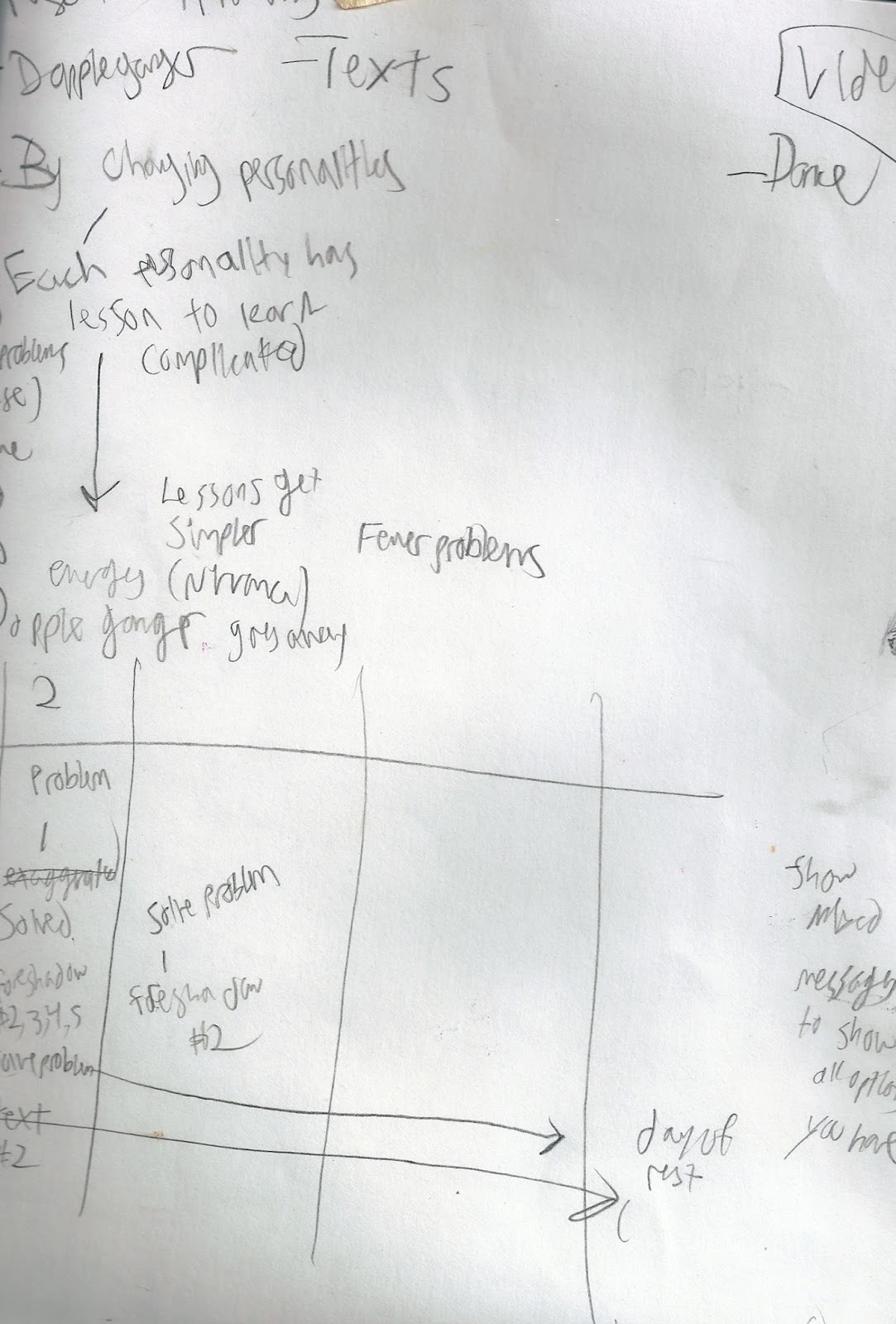
The project evolved drastically. At first, I was working on a film that would explore me though other people. There would be a certain time in the day where everyone would change personalities, and the main character would have to find out why this was happening. I didn't flesh out my idea fast enough, and didn't have enough confidence behind it, so was put in a group project with Kaitlyn, who wanted to work with dance.
I'm not used to working with others, and I didn't know a lot about choreography, and how it would fit into my idea, so I was hesitant at first. The element of comedy was new for me, too, and I was curious about how this would turn out. Kaitlyn was a good partner to work with. We stayed on task, and she was very cooperative. We both ditched ideas we had before, and started working on a new plot (that had to have me as the main character, because we were assigned to it.) At first, the story started off with a more serious tone, with the girl's problems. A doppelganger, the manifestation of the girl's inner self, would help the girl solve the problems through her dreams. We felt as if the story needed a kick to it to give it more depth- to pull the audience in- and Luke helped us when we brought our predicament to him. He suggested approaching the story from the fairy's point of view, in order give the story a fresh take. He also put out an idea that the fairy should be bored of doing her job; this would add another layer to the movie.
We spent most of the time plotting out the story. We agreed that the story should have a format to it, in order to emphasize how the girl's problems were slowly being solved. It would also help establish when dream sequences would appear. Kaitlyn choreographed simple dances so non-Dancers like me could even do them.
I didn't like the fact that the story was turning into a female myth, myths where the main character has their problems solved for them (I like male myths better, where the main character solves their own problems.) But the story itself was interesting, so I stuck with it.
 |
| Some papers from our brainstorming process |
Filming was tough. I should have brought my tripod in so we could film it by ourselves better. We also should have planned out the shots more precisely. Additionally, extras kept on forgetting to bring their clothes (which were needed for continuity) and that delayed filming by a few days. But that doesn't mean that filming was boring. It was exciting working with other people and trying to learn the dance steps. Acting in front of the camera wasn't too bad, either. Most of the roles required me to act in everyday settings, so I tried to keep it natural.
We also created a symbiotic relationship with Anika's project. We had a part where I get a makeover, which Anika did, and in turn, she used our footage covering the transformation for her makeup film. I had never gotten my makeup done, and it was a very different experience... I hardly recognized myself when it came time to look in the mirror! (But I'm not going to put on eye makeup anytime soon. It felt like there was constantly something in my eye.)
In retrospect, we should have spent more time editing, also. Originally, we planned that Kaitlyn would edit a first draft, and I would go over it, since I had to edit another video for another class. It turned out that we ran out of time, so we only had the rough draft to show at STAC live. If I could do that over, I'd put together the first draft, even if I could only edit for a couple hours.
Luke pointed out that the plot of this film was similar to my animation last year. The stress of school, and the feelings of being restricted that come with it, have a big influence on my life, especially this year, and it seems that these feelings have translated into this project, too.
New influences:
Persona 4:
Persona 4 is a video game that explores humanity in a unique way. I absolutely loved how they addressed personal issues: the characters would grapple with their dark sides in a land inside of the TV. Loneliness, denying the truth, sexuality, the nature of friendship, and the facades "used to overcome life's hardships" were some issues explored in the game. I liked how the game was more about the characters looking inward, and dealing with their inner troubles, rather than simply fighting a demon to save the princess. I found it to be extremely creative and inspiring. (The game's music is great, too.)
Midnight in Paris:
Midnight in Paris is another very creative piece of media that I discovered this year. I love the concept of time travel, and the fact that the main character travels back to my favorite time, the 1920's, made me love it even more. Although the message was presented more explicitly than i would have liked it to be, I liked how Woody Allen combined fantasy elements with modern settings in order to convey that the grass is always greener elsewhere.
How Much Does Your Building Weigh, Mr. Foster?:
link
This beautiful documentary visited my love of modern architecture. Every shot was clear and presented each building as livable sculptures. Mr. Foster is a very thoughtful, very quiet, man and it's admirable how he makes buildings functional, yet beautiful, such as the Hearst tower in NYC, which utilizes its unusually shaped design to capture water that can be reused for the building's AC. I'm not planning to become an architect, but this documentary introduced a thoughtful mind of an artist at work, and that was very inspiring.
Beauty is Embarrassing:
link
This documentary introduced an artist that dabbled in many mediums, and has only recently become well-known in the art world. In his life, Wayne White has painted, voice acted, illustrated, animated, created puppets, and designed sets. He is very honest about himself, and isn't afraid to assert his independence (for example, when people compared some of his word paintings to another man, he created a painting called "Hoozy Thinky Iz?"). I liked how he wasn't afraid of combining mediums, or transferring ideas from medium to medium, at one point he says that he would like to turn a painting into a set, or a set into a painting. He knows how hard its been in the art world (he started to get depressed at a time), and because of that he's begun to live life as he wants to, which I find very admirable. He's very confident and lives life doing what he likes. The tone of the movie was very light-hearted, and it was great to see an artist having a satisfying life.