A few weeks ago I attended the Gold Cost Film Festival's "Great Shorts 1."
I attended "Great Shorts 2" last year, and was looking forward to another great viewing of short films, and I was disappointed.
...Ok, I was only a little disappointed, but that was because there weren't any animated shorts (last year I remember seeing a few really creative ones.)
The shorts had extremely interesting concepts, many of them addressing modern issues. All of the films were realistic, and in a modern setting. I'll do a one-sentence summary and small, three-sentence review since there were a lot of shorts:
THE COME UP: A screen writer's quirky scam in order to get the funds to execute his film.
I wasn't terribly impressed with the plot until the end. The short was a chase scene, which cutely utilized film sets and movie props as weapons, but it didn't seem too original. At the end there was a clever plot twist (the chaser turned out to be the real thief), and this slightly redeemed the short.
THE EXCHANGE: In a world where people trade shares of themselves, an ex-girlfriend takes revenge.
The concept of this film was interesting, but the characters annoyed me; both main characters seemed not to have any redeeming features (the guy only cared about himself, and the ex was very nasty). The end, however, was amusing when the ex bought her boyfriend. I like how she flipped his break-up line "it's not personal, it's business" into "it's not business, it's personal."
DRONE: A military drone operator's morning routine.
The acting and tone of the film was excellent. The film seemed so surreal with the setting of a drone operator working alone in an office contrasted with the setting of his target in a desert thousands of miles away. The acting of the operator was at its peak the moment the drone dropped the bomb; it seemed like a video game, but when the operator started crying you realized the gravity of the situation.
FIRST THE WORST: Two young children debate who has the worst life.
This short was too short. The concept was cute, and the acting from the two kids was amazing. I loved the electricity between them when they were arguing over who had the worst life.
POSTMODERN TIMES: A humorous look at the modern lifestyle of increasingly-omnipresent technology.
I haven't seen the Charlie Chaplin film this short was based off of, and I'd like to. A well-done satire on modern technology...I loved the scene where the woman goes to work in her home office, and has to deal with multiple video chats and telephone calls. The scene where the power goes out, and the woman and her neighbor meet each other in real life was hilarious, yet painful (both were only dressed from the hips-up, since that's the only part visible in webcams.)
THE AUDITION: A short satire about how cut-throat the auditioning process is.
Exaggeration really makes this movie. I really like how the movie comes in a circle, beginning with the woman auditioning as "clipboard woman," progressing into the woman vomiting on command, then ending with the woman introducing herself as "clipboard woman" before leaving. It was hard to watch, but the message was clear.
SEPARATE WE COME, SEPARATE WE GO: A short about a girl and a friendly grown-up bonding.
One of the darker films in the short, the acting in this movie was very good. One of my favorite lines from the whole day was something along the lines of, "A boy in my class wanted to sail to France in a frying pan so he'd be kept warm."The transition from growing up fast, to momentarily regaining innocence was done well.
TIME FREAK: An inventor becomes caught up in the minutiae of daily life...and time traveling.
This short gave time travel a fresh light, which I respect, and I loved the inclusion of humor (the seriousness of the situation becomes insidious with the movie being mainly humorous). The acting was great, the actor of time traveller character really got across the transition from a slightly nerdy guy, to an OCD mad scientist. The ending came up a little short, however, because the character of the friend is now stuck in the past since he convinces his friend to not build a time machine (but I suppose it's believable, since he did make a snap judgement.)
SUDDEN DEATH!: Two scientists must battle a disease that causes sudden singing and dancing, while dealing with their true feelings of affection.
This film was hilarious in that it was a mock musical (it vaguely reminded me of Dr. Horrible), however the plot was a little confusing. The film felt a little long at times, too. I liked at the end the cast broke off into their ordinary lives before finishing the last line of the song...the sudden jump into reality made the film even more humorous!
---
After the shorts, there was a short discussion with the lady who chose all of the films (there was going to be a Q&A with the directors, but no one showed up). Apparently, anyone can submit shorts! ...Could this be a future project for STAC?
Showing posts with label 2013. Show all posts
Showing posts with label 2013. Show all posts
Saturday, November 9, 2013

-16.4-
I believe the Shakespeare workshop, taught by James III, was my first pure acting workshop in STAC. I enjoyed it, but felt a little shy because I'm not usually an 'acting' person.
As I discussed when writing about the Shakespeare documentaries, Shakespeare IS about debating the meaning of the work, and presenting your results on stage, but it's also about making sure the audience can see your actions (it's also about getting used to speaking in iambic pentameter.)
During this workshop, we mainly focused on making our actions big (as if people in another room had to see us present Shakespeare.)
Before the workshop, we all chose a sonnet (it couldn't be the more popular sonnets). I chose sonnet LXV (65) because I thought the rhythm of the words was calming.
After warming up and introducing ourselves, we reviewed how the iambic pentameter sounds, then read the first line of our sonnets in this way. For some, breaking down the syllables was a bit harder than others, but we all managed to say our lines smoothly.
Next, we focused on action. We chose words in the sonnet that stood out to us, then thought about actions that suited each word. When comfortable, we silently performed the actions, then added sound effects to the action.
I was used to focusing on action, rather than getting into the mind-frame, from Luke's acting advice, but yesterday was different since we had a physical "script" to act from.
Acting individual words out of context seemed a little strange to me, but when people started to present their sonnet to the group; the actions fit the meaning of the sonnet!
After the initial performance, James started to go over making movements bigger (be big because you can always pull back if needed), and adding in context. For example, Brian's sonnet was directed towards a love intrest, so James had one of the girls stand next to him, and the rest of the guys stand up, so Brian had actual people to refer to while acting. Since many people had sonnets that involved antithesis, James encouraged them to emphasize the differences in order to get the meaning across even clearer.
When I went, I was nervous, but I tried to speak clearly and with the iambic pentameter in mind (people before me had some trouble with destressing words commonly stressed. The night before I didn't have time to go over the meaning of the sonnet, so I acted blindly. It went all right, and after we discussed the meaning of the sonnet (although time erodes everything, I hope my love for you in this letter withstands time). Without meaning to, I emphasized the meaning of "rocks impregnable"by pausing before doing my action for rock (James said the pause interrupted the rhythm, showing how even the words were stopped by the strength of the metaphorical stone.)
After I went, we ran out of time, so we recapped what we went over. While recapping, I began to think about how hard acting Shakespeare is. There are many ways of approaching it, and it's easy to get caught up in your approach to acting. However, when it was my turn, almost everything went blank. I suppose in the end it's as Charlie Parker says: "Then you practice, practice, practice. And then, when you finally get up there on the bandstand, forget all that and just wail."
As I discussed when writing about the Shakespeare documentaries, Shakespeare IS about debating the meaning of the work, and presenting your results on stage, but it's also about making sure the audience can see your actions (it's also about getting used to speaking in iambic pentameter.)
During this workshop, we mainly focused on making our actions big (as if people in another room had to see us present Shakespeare.)
Before the workshop, we all chose a sonnet (it couldn't be the more popular sonnets). I chose sonnet LXV (65) because I thought the rhythm of the words was calming.
After warming up and introducing ourselves, we reviewed how the iambic pentameter sounds, then read the first line of our sonnets in this way. For some, breaking down the syllables was a bit harder than others, but we all managed to say our lines smoothly.
Next, we focused on action. We chose words in the sonnet that stood out to us, then thought about actions that suited each word. When comfortable, we silently performed the actions, then added sound effects to the action.
I was used to focusing on action, rather than getting into the mind-frame, from Luke's acting advice, but yesterday was different since we had a physical "script" to act from.
Acting individual words out of context seemed a little strange to me, but when people started to present their sonnet to the group; the actions fit the meaning of the sonnet!
After the initial performance, James started to go over making movements bigger (be big because you can always pull back if needed), and adding in context. For example, Brian's sonnet was directed towards a love intrest, so James had one of the girls stand next to him, and the rest of the guys stand up, so Brian had actual people to refer to while acting. Since many people had sonnets that involved antithesis, James encouraged them to emphasize the differences in order to get the meaning across even clearer.
When I went, I was nervous, but I tried to speak clearly and with the iambic pentameter in mind (people before me had some trouble with destressing words commonly stressed. The night before I didn't have time to go over the meaning of the sonnet, so I acted blindly. It went all right, and after we discussed the meaning of the sonnet (although time erodes everything, I hope my love for you in this letter withstands time). Without meaning to, I emphasized the meaning of "rocks impregnable"by pausing before doing my action for rock (James said the pause interrupted the rhythm, showing how even the words were stopped by the strength of the metaphorical stone.)
After I went, we ran out of time, so we recapped what we went over. While recapping, I began to think about how hard acting Shakespeare is. There are many ways of approaching it, and it's easy to get caught up in your approach to acting. However, when it was my turn, almost everything went blank. I suppose in the end it's as Charlie Parker says: "Then you practice, practice, practice. And then, when you finally get up there on the bandstand, forget all that and just wail."
Sunday, November 3, 2013
-15.4-
Part 2:
While staying at a family friend's house in Seattle, I watched two Shakespeare documentaries.
Henry IV/V:
I watched henry IV/V documentary in Seattle to make up for missing the airing of the actual Henry IV (pt 2), and I loved it.
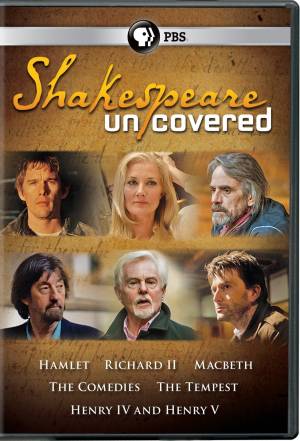
The film gave great context for both plot and film techniques (the fact that Jeremy Irons narrated the film was a plus, too!). It talked about the writing behind the play, and filming behind the scenes bits of the Hollow Crown. (It amazed me to see how much background noise there was before editing.)
The film introduced some interesting creative concepts. For example, Shakespeare broke a STAC rule by having a disclaimer at the beginning of Henry V - He apologized for not being able to have many set changes, so the audience would have to use their imagination for when scenes changed to more ambitious settings!
...Conversely, Shakespeare followed a STAC rule by stealing the French Bishop's speech.
The ardour of the Shakespearian researchers and actors fascinated me. I have mixed feelings about Shakespeare, but seeing these people talk so enthusiastically about Shakespeare made me enjoy the documentary even more. I found Shakespearian acting very interesting...In a way, the actors are physical scholars - they debate the meaning of the plays academically, then put their collective interpretation on stage to the judgment of the audience. The age of the play also put into context English history with American history. The play happened hundreds of years before Shakespeare's time, and Shakespeare was hundreds of years before the Revolutionary War was even fought!
The last scene of the documentary addressed the theme of how futile war is. In Henry V, the poor fight the battles of the king, and take enormous losses; France is conquered, then in the next generation everything gained is lost. "Have we really moved on?" Mr. Irons asks, as he walks through an Arlington-like grave in France.
Although a bit off-topic from the plays, I thought this message was very powerful. It really connected Shakespeare to the world at large.
Richard II:
I went in reverse order, since Richard II, Henry IV, and Henry V are a trilogy, and I slightly regret doing that, since Richard II gave even greater context to the Henry IV/V documentary.
I was fascinated before with the contrasting appearance of the three kings, especially the pure look of Richard II, and the documentary provided me with the explanation of Richard II's, which made me even more interested in this elusive character.
The documentary portrays Richard II as a king who believed he was actually from God. The director chose to have Richard behave as if he was a saint, as if he was above humanity. From the few clips I have seen from Richard II, I must say that the Mr. Whishaw pulled the character off excellently! An added bonus is that Mr. Whishaw acted in Cloud Atlas, a STAC film from last year! His character as Richard II seems to be quite a contrast with the composer character from Cloud Atlas...
I do admit, the second half of the documentary was a bit drier, but I found the introspection into the King's character most interesting. As I've said, I loved both of the documentaries, and I really must watch the Hollow Crown!
-14.4-
It's been a while, but when I went college visiting to Seattle last month, I added a lot to my library. I experienced my first overnight stay at a college, and I remembered how much I loved the climate, and the nice blend between urban and natural beauty Seattle has to offer.
I was also exposed to very interesting TED talks, and Shakespeare documentaries on the plane, and during my stay.
Part 1
TED talks:
On the ride to and from Seattle,


TED: Beyond Looks
This short talk provided an interesting look into the lives of models. The model here talked about how she thought it was so odd how girls want to have an occupation where they just need to look pretty, instead of having an occupation where they could be a "ninja cardio-thoracic surgeon poet."
TED: Fashion Lesson
This fashion designer went into the culture of fashion, and how their lax copyright laws allows for innovation and competition. I thought this was an interesting, since I'm a supporter of the protection of intellectual property. The video also goes into the positives of copying! (Something we've discussed a lot in STAC.) The most interesting part of the video was that the idea of free copying made others strive to make something so unique that no one would be able to copy it (ex. where all those crazy fashion designs come from!)
TED: Learn to read Chinese with Ease!
In this TED talk, a basic chinese lesson is taught (with radicals). I knew the concept before, but the way ShaoLan incorporates humor into an educational lesson -the part where two women characters together symbolizing the character for argument made me smirk- impressed me.
TED: Elusive Creativity
The author in this TED talk discusses a very interesting concept on genius. When she introduced the topic, she talked about how people asked her if she'd ever create another best-seller. This is how I feel about my animation (after the great piece I made in 10th grade, I haven't had any tremendous ideas, which scares me), so this talk touched me on a very personal level.
The author talks about the origins of genius. A "genius" was actually a familiar, or muse, that lived in creative people's homes and helped them with works of art. Only recently has the word "genius" been attributed towards the person themselves. The author connected this to the pressure "geniuses" face because of this re-alignment in association, and why "geniuses" often become mad and suicidal.
The concept of allowing yourself times of lethargy was very different for me, but I do agree with the author in that you still try and create work during these flatline times, until your muse decides to pitch in again.
I was also exposed to very interesting TED talks, and Shakespeare documentaries on the plane, and during my stay.
Part 1
TED talks:
On the ride to and from Seattle,


TED: Beyond Looks
This short talk provided an interesting look into the lives of models. The model here talked about how she thought it was so odd how girls want to have an occupation where they just need to look pretty, instead of having an occupation where they could be a "ninja cardio-thoracic surgeon poet."
TED: Fashion Lesson
This fashion designer went into the culture of fashion, and how their lax copyright laws allows for innovation and competition. I thought this was an interesting, since I'm a supporter of the protection of intellectual property. The video also goes into the positives of copying! (Something we've discussed a lot in STAC.) The most interesting part of the video was that the idea of free copying made others strive to make something so unique that no one would be able to copy it (ex. where all those crazy fashion designs come from!)
TED: Learn to read Chinese with Ease!
In this TED talk, a basic chinese lesson is taught (with radicals). I knew the concept before, but the way ShaoLan incorporates humor into an educational lesson -the part where two women characters together symbolizing the character for argument made me smirk- impressed me.
TED: Elusive Creativity
The author in this TED talk discusses a very interesting concept on genius. When she introduced the topic, she talked about how people asked her if she'd ever create another best-seller. This is how I feel about my animation (after the great piece I made in 10th grade, I haven't had any tremendous ideas, which scares me), so this talk touched me on a very personal level.
The author talks about the origins of genius. A "genius" was actually a familiar, or muse, that lived in creative people's homes and helped them with works of art. Only recently has the word "genius" been attributed towards the person themselves. The author connected this to the pressure "geniuses" face because of this re-alignment in association, and why "geniuses" often become mad and suicidal.
The concept of allowing yourself times of lethargy was very different for me, but I do agree with the author in that you still try and create work during these flatline times, until your muse decides to pitch in again.
Saturday, September 28, 2013
-11.3-
Assignment: Search at least 3 words that you like in a google search. Share a link that interests you.
Attempt 1: I searched "science, paper, craft" and was lead to this link. A periodic table paper craft! But...the website didn't explain what the varying heights of the elements represented...perhaps its electronegativity (I see Flourine is 4.0 and it's EN value is 4.0.)?
I hadn't really thought about it, but using paper craft as learning tools could be a fun way to teach science. It's easy for students to make, and is extremely interactive. Now that I'm thinking about it...I remember making DNA mobiles in 7th grade. That was fun, and I still remember what parts of the mobile represent!
Attempt 2: Since papercraft is really one word, I googled "
An Atlantic article came up (one of my favorite magazines) so I had to click on it!
http://www.theatlantic.com/video/archive/2013/01/one-kids-sci-fi-short/267320/
One man wrote, directed, and animated a science fiction short at the age of 22 (I don't see why the age matters). The plot of the film is simple, machines fighting against man, but I liked the twist at the end (Slight spoilers here: the ending was painful, since you know a catastrophe is going to happen.) What really amazed me was that one person animated the entire short. The level of detail in the animation was incredible. The article said that it took him 7 months to animate 5 minutes of film. Drawing upon my experience at self-animating, that's a short amount of time!
Attempt 1: I searched "science, paper, craft" and was lead to this link. A periodic table paper craft! But...the website didn't explain what the varying heights of the elements represented...perhaps its electronegativity (I see Flourine is 4.0 and it's EN value is 4.0.)?
I hadn't really thought about it, but using paper craft as learning tools could be a fun way to teach science. It's easy for students to make, and is extremely interactive. Now that I'm thinking about it...I remember making DNA mobiles in 7th grade. That was fun, and I still remember what parts of the mobile represent!
Attempt 2: Since papercraft is really one word, I googled "
An Atlantic article came up (one of my favorite magazines) so I had to click on it!
http://www.theatlantic.com/video/archive/2013/01/one-kids-sci-fi-short/267320/
One man wrote, directed, and animated a science fiction short at the age of 22 (I don't see why the age matters). The plot of the film is simple, machines fighting against man, but I liked the twist at the end (Slight spoilers here: the ending was painful, since you know a catastrophe is going to happen.) What really amazed me was that one person animated the entire short. The level of detail in the animation was incredible. The article said that it took him 7 months to animate 5 minutes of film. Drawing upon my experience at self-animating, that's a short amount of time!
Tuesday, September 24, 2013
-10.4-
I liked doing the psychogeography assignment in school today. (I wish I could have snuck some abstract photos during class, but I didn't get the opportunity.) The assignment fit with my general approach to photography: take abstract photos in order to redefine the world for others.
 |
| A photo I took a few months ago (A glass with juice in it) |
-9.4-
A small observation. Aka "Aha, I think I found some stealing in progress!"
While watching the anime Shingeki no Kyojin, I noticed that a scene in the second opening had the exact animation sequence to The Avengers credits. It amused me that the animators directly took the style from a comic-book movie.
While watching the anime Shingeki no Kyojin, I noticed that a scene in the second opening had the exact animation sequence to The Avengers credits. It amused me that the animators directly took the style from a comic-book movie.
Friday, September 13, 2013
-3.4-
When I came home, I still had a headache, so I took a nap, and put on some background noise in the form of listening to episodes of Welcome to Nightvale. Before I drifted off to sleep, I realized that there were a lot concepts that could be stolen, and that I should blog about this. I also thought the concept was very interesting and wanted to share it with everyone.

Welcome to Nightvale is a podcast in the format of a (fictional) radio newscast. The news covers various events in the desert town of Nightvale, USA, and is divided into two parts with a musical "weather" forecast as a interlude.
Events in Nightvale are more than slightly off-kilter; hooded figures and angels wander around the town, a "glowcloud" is a member of the high school PTA, and many odd events are hushed up by "the sheriff's secret police,"...the casual tone of the show's host only brings out the show's eccentricity. The podcast also parodies aspects of our daily life such as the "word from our sponsors" ("That word... is carp!"-Episode 7) It's amusing and slightly creepy at the same time.
The music is excellent. The style of both the background music and "weather" song fits the strange tone of the podcast.
This show is enjoyable for those who like something out of the ordinary that's slightly sarcastic, slightly creepy, slightly humorous, slightly quirky, and slightly Orwellian.
I'd really like to steal the idea of creating fictional news. I also like how simple the podcast is. The cast is composed of one person, the show's host, and I imagine this makes production relatively fast. Definitely doable.
Official website
Soundcloud Official Playlist
Marketing: Surprisingly, the podcast is free. However, the company have a store on their website, and links to other books they have produced.
When looking at the website, I saw that they sell tickets to live shows (I never knew they had live shows before!) And they're in NY! I'm not sure if we'd be able to sell tickets to STAC live...perhaps a special event?

Welcome to Nightvale is a podcast in the format of a (fictional) radio newscast. The news covers various events in the desert town of Nightvale, USA, and is divided into two parts with a musical "weather" forecast as a interlude.
Events in Nightvale are more than slightly off-kilter; hooded figures and angels wander around the town, a "glowcloud" is a member of the high school PTA, and many odd events are hushed up by "the sheriff's secret police,"...the casual tone of the show's host only brings out the show's eccentricity. The podcast also parodies aspects of our daily life such as the "word from our sponsors" ("That word... is carp!"-Episode 7) It's amusing and slightly creepy at the same time.
The music is excellent. The style of both the background music and "weather" song fits the strange tone of the podcast.
This show is enjoyable for those who like something out of the ordinary that's slightly sarcastic, slightly creepy, slightly humorous, slightly quirky, and slightly Orwellian.
I'd really like to steal the idea of creating fictional news. I also like how simple the podcast is. The cast is composed of one person, the show's host, and I imagine this makes production relatively fast. Definitely doable.
Official website
Soundcloud Official Playlist
Marketing: Surprisingly, the podcast is free. However, the company have a store on their website, and links to other books they have produced.
When looking at the website, I saw that they sell tickets to live shows (I never knew they had live shows before!) And they're in NY! I'm not sure if we'd be able to sell tickets to STAC live...perhaps a special event?
Friday, June 14, 2013
-52.3-
A Major
What is your major area of emphasis for Q4? This is where are you applying the majority of your time and energy.
Self-exploration via. various mediums, probably geared towards a short film (film? animation? combination?)
Are you exploring, or are you working towards a finished product?
Working towards a finished project that explores. (I plan for a finished product, and I hope I'll be done by that time.)
What do you envision as the end result?
Me covering my eyes while everyone else watches. (It's too scary to think about!)
Are you working alone or do you have collaborators?
Probably working alone.
Who are your community?
I'm not sure. People at my lunch table?
Where are you now, where will you get to?
Right now I'm not quite sure how this will turn out. I have a loose framework that is able to be rearranged. By the end I hope to have a product
What are 5 criteria with which we will evaluate your work on this this quarter?
1. Completedness: Does the product seem finished?
2. Effort: Does the project look like it took the time it did to work on it?
3. Fun: Does it look like Shiana had fun?
4. Risk: Has this project taken any risks? How risky are the risks?
5. Blank space: Does the project leave room for expansion?
-53.3-
It's been a while since I posted here! (School became really busy, so it was hard to write, even when I downloaded the blogger app...)
This quarter I worked on two minor projects, a major project, saw a lot of documentaries about artists, and discovered some creative fictional pieces. I continued along paths that I enjoy traveling, tried some new ones (such as starring in a film, and putting on makeup), learned about paths other artists took, and learned about different ways of working with creativity.
Minor projects:
Paper crafting:
I discovered the joys papercraft during Shoshtigigi, where we had to make a voodoo doll of the person's name we drew. I had heard of papercraft before, and decided to give it a try. I discovered that it was a challenge to make a papercraft, so I took a template of a girl papercraft I found online and edited it so it looked like Caitlin, the person whose name I drew. It was fun working with my hands, so I started making more papercrafts during winter break. I stopped for a little, because of school, but in the 4th quarter I started making papercrafts of a few of my characters. It was challenging making different pieces of clothing. Proportions had to be measured, and the only way to truly check if the model worked was to make it; it was a trial-and-error process, but it was gratifying to see my characters become 3D.
Paper crafting:
I discovered the joys papercraft during Shoshtigigi, where we had to make a voodoo doll of the person's name we drew. I had heard of papercraft before, and decided to give it a try. I discovered that it was a challenge to make a papercraft, so I took a template of a girl papercraft I found online and edited it so it looked like Caitlin, the person whose name I drew. It was fun working with my hands, so I started making more papercrafts during winter break. I stopped for a little, because of school, but in the 4th quarter I started making papercrafts of a few of my characters. It was challenging making different pieces of clothing. Proportions had to be measured, and the only way to truly check if the model worked was to make it; it was a trial-and-error process, but it was gratifying to see my characters become 3D.
 |
| My papercraft exhibition at STAC night |

Figure drawing:
I wanted to work on figure drawing this quarter. First I drew some figures in my usual technique.
 |
| These two examples weren't the ones I showed to Luke. (I couldn't find those.) |

Then I showed them to Luke, and he suggested that I use the coiling technique. He sent me out for an hour to draw people in school using this technique. He also made me use pen, so I couldn't erase any mistakes (the point was to draw quickly).


 |
| Some sketches using the 3D technique |
This quarter, my main project was a group film with Kaitlyn Fox.
The plot of the film followed the adventure of a fairy and a girl as they both struggle to fix the girl's problems. The fairy hates her job, but when everything is solved, she finds that she's bored, and thus gives the girl a new problem that the fairy can solve.
The project evolved drastically. At first, I was working on a film that would explore me though other people. There would be a certain time in the day where everyone would change personalities, and the main character would have to find out why this was happening. I didn't flesh out my idea fast enough, and didn't have enough confidence behind it, so was put in a group project with Kaitlyn, who wanted to work with dance.
I'm not used to working with others, and I didn't know a lot about choreography, and how it would fit into my idea, so I was hesitant at first. The element of comedy was new for me, too, and I was curious about how this would turn out. Kaitlyn was a good partner to work with. We stayed on task, and she was very cooperative. We both ditched ideas we had before, and started working on a new plot (that had to have me as the main character, because we were assigned to it.) At first, the story started off with a more serious tone, with the girl's problems. A doppelganger, the manifestation of the girl's inner self, would help the girl solve the problems through her dreams. We felt as if the story needed a kick to it to give it more depth- to pull the audience in- and Luke helped us when we brought our predicament to him. He suggested approaching the story from the fairy's point of view, in order give the story a fresh take. He also put out an idea that the fairy should be bored of doing her job; this would add another layer to the movie.
We spent most of the time plotting out the story. We agreed that the story should have a format to it, in order to emphasize how the girl's problems were slowly being solved. It would also help establish when dream sequences would appear. Kaitlyn choreographed simple dances so non-Dancers like me could even do them.
I didn't like the fact that the story was turning into a female myth, myths where the main character has their problems solved for them (I like male myths better, where the main character solves their own problems.) But the story itself was interesting, so I stuck with it.
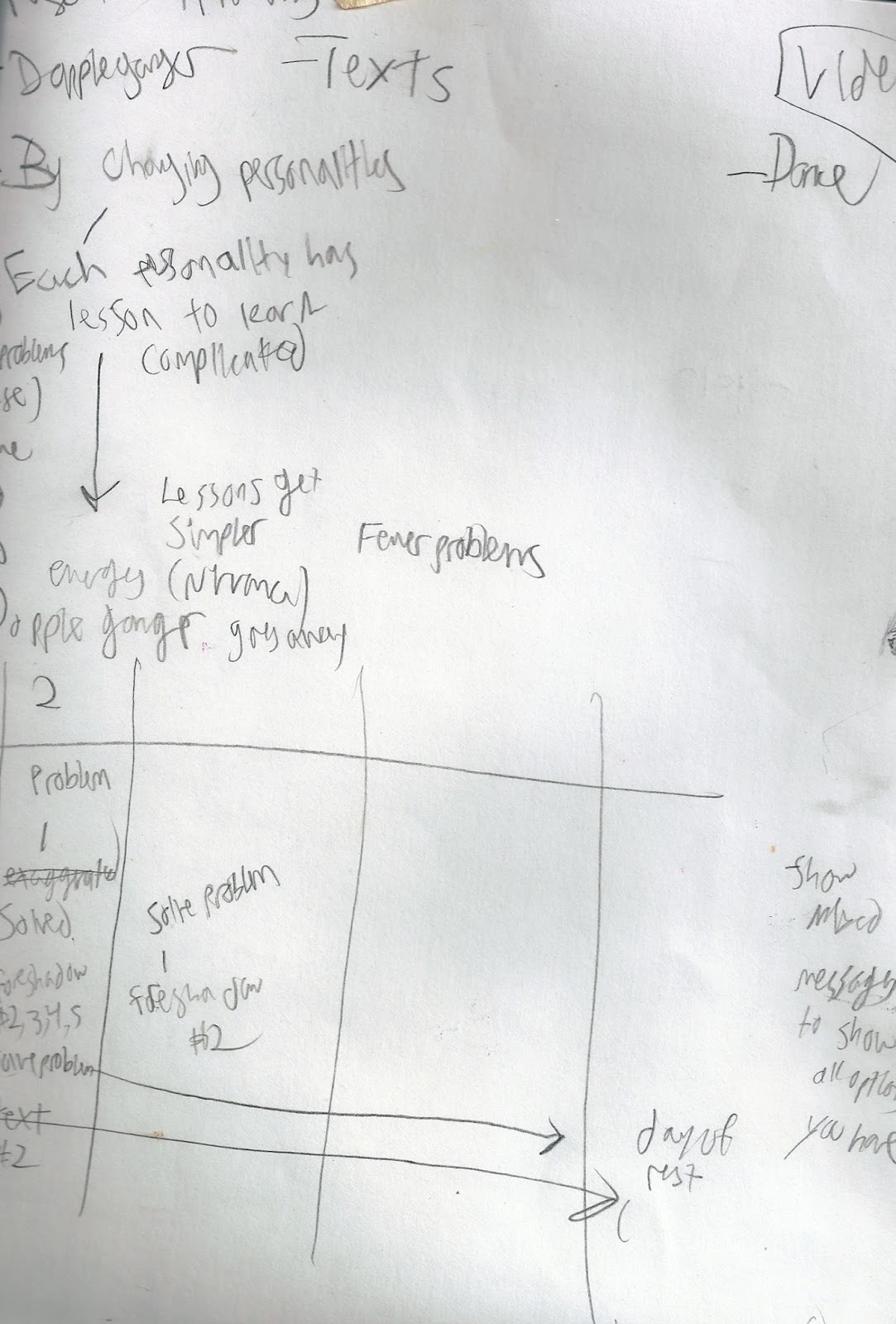 |
| Some papers from our brainstorming process |


Filming was tough. I should have brought my tripod in so we could film it by ourselves better. We also should have planned out the shots more precisely. Additionally, extras kept on forgetting to bring their clothes (which were needed for continuity) and that delayed filming by a few days. But that doesn't mean that filming was boring. It was exciting working with other people and trying to learn the dance steps. Acting in front of the camera wasn't too bad, either. Most of the roles required me to act in everyday settings, so I tried to keep it natural.
We also created a symbiotic relationship with Anika's project. We had a part where I get a makeover, which Anika did, and in turn, she used our footage covering the transformation for her makeup film. I had never gotten my makeup done, and it was a very different experience... I hardly recognized myself when it came time to look in the mirror! (But I'm not going to put on eye makeup anytime soon. It felt like there was constantly something in my eye.)
In retrospect, we should have spent more time editing, also. Originally, we planned that Kaitlyn would edit a first draft, and I would go over it, since I had to edit another video for another class. It turned out that we ran out of time, so we only had the rough draft to show at STAC live. If I could do that over, I'd put together the first draft, even if I could only edit for a couple hours.
Luke pointed out that the plot of this film was similar to my animation last year. The stress of school, and the feelings of being restricted that come with it, have a big influence on my life, especially this year, and it seems that these feelings have translated into this project, too.
New influences:
Persona 4:
Persona 4 is a video game that explores humanity in a unique way. I absolutely loved how they addressed personal issues: the characters would grapple with their dark sides in a land inside of the TV. Loneliness, denying the truth, sexuality, the nature of friendship, and the facades "used to overcome life's hardships" were some issues explored in the game. I liked how the game was more about the characters looking inward, and dealing with their inner troubles, rather than simply fighting a demon to save the princess. I found it to be extremely creative and inspiring. (The game's music is great, too.)
Midnight in Paris:
Midnight in Paris is another very creative piece of media that I discovered this year. I love the concept of time travel, and the fact that the main character travels back to my favorite time, the 1920's, made me love it even more. Although the message was presented more explicitly than i would have liked it to be, I liked how Woody Allen combined fantasy elements with modern settings in order to convey that the grass is always greener elsewhere.
How Much Does Your Building Weigh, Mr. Foster?:
link
This beautiful documentary visited my love of modern architecture. Every shot was clear and presented each building as livable sculptures. Mr. Foster is a very thoughtful, very quiet, man and it's admirable how he makes buildings functional, yet beautiful, such as the Hearst tower in NYC, which utilizes its unusually shaped design to capture water that can be reused for the building's AC. I'm not planning to become an architect, but this documentary introduced a thoughtful mind of an artist at work, and that was very inspiring.
Beauty is Embarrassing:
link
This documentary introduced an artist that dabbled in many mediums, and has only recently become well-known in the art world. In his life, Wayne White has painted, voice acted, illustrated, animated, created puppets, and designed sets. He is very honest about himself, and isn't afraid to assert his independence (for example, when people compared some of his word paintings to another man, he created a painting called "Hoozy Thinky Iz?"). I liked how he wasn't afraid of combining mediums, or transferring ideas from medium to medium, at one point he says that he would like to turn a painting into a set, or a set into a painting. He knows how hard its been in the art world (he started to get depressed at a time), and because of that he's begun to live life as he wants to, which I find very admirable. He's very confident and lives life doing what he likes. The tone of the movie was very light-hearted, and it was great to see an artist having a satisfying life.
Subscribe to:
Posts (Atom)